Best Water Softener for Katy, Texas: What to Know Before You Buy
A water softener in Katy is not solving a hypothetical problem. In this part of West Houston, many households are dealing with hard to very hard municipal water, and in a lot of neighborhoods that means roughly 10 to 18 grains per gallon, or about 170 to 308 mg/L as CaCO3, depending on whether your utility is still groundwater-heavy or already blending in more imported surface water. That range is exactly why the Best Water Softener Katy, TX search should be city-specific, not generic. After evaluating systems against Katy’s mixed utility landscape, the SoftPro Elite comes out as the overall winner because it handles both hardness and disinfectant stress better than most residential units in this price class.
Take Priya and Daniel Varela in Elyson. Priya is a registered nurse, Daniel is a civil engineer, and their four-person household moved into a newer home expecting fewer maintenance headaches, not more. Within the first year, they were already scrubbing white film off shower glass, replacing a scaled-up coffee maker, and noticing their gas water heater recovering more slowly. Their district’s water profile was different from what Daniel had seen in central Houston, and the failed fix was familiar: a salt-free conditioner that reduced spotting slightly but did not actually remove calcium and magnesium.
Katy’s challenge is that “Katy water” is not one uniform supply. Inside the City of Katy, some customers still see a stronger groundwater influence from Gulf Coast Aquifer wells, while many Katy-area MUDs in Harris and Fort Bend counties are now on a blend shaped by regional surface water conversion through the West Harris County Regional Water Authority and North Fort Bend Water Authority. That affects hardness, chlorine chemistry, sizing, and long-term resin life. The sections below break down exactly what that means before you buy.
Key Takeaways
- 10–18 GPG is the practical hardness range many Katy households should plan around, and that is high enough to justify true ion exchange rather than salt-free conditioning.
- Katy-area disinfectant chemistry is not uniform; many neighborhoods receiving imported surface water are on chloramine residuals, which makes 8% crosslink resin a real advantage, not a brochure detail.
- SoftPro Elite is independently validated through NSF 372 lead-free certification and IAPMO materials safety certification, which matters for a treated municipal supply serving fast-growing suburban homes.
- For a four-person Katy family using 75 gallons per person per day at 15 GPG, the sizing math lands at 4,500 grains per day, which puts a 48K or 64K system into serious consideration.
- Compared with dealer-heavy brands and big-box timer units sold around Katy, SoftPro Elite usually delivers the strongest ROI in its class because upflow regeneration can cut salt use by up to 75% and water use by up to 64% versus conventional downflow systems.
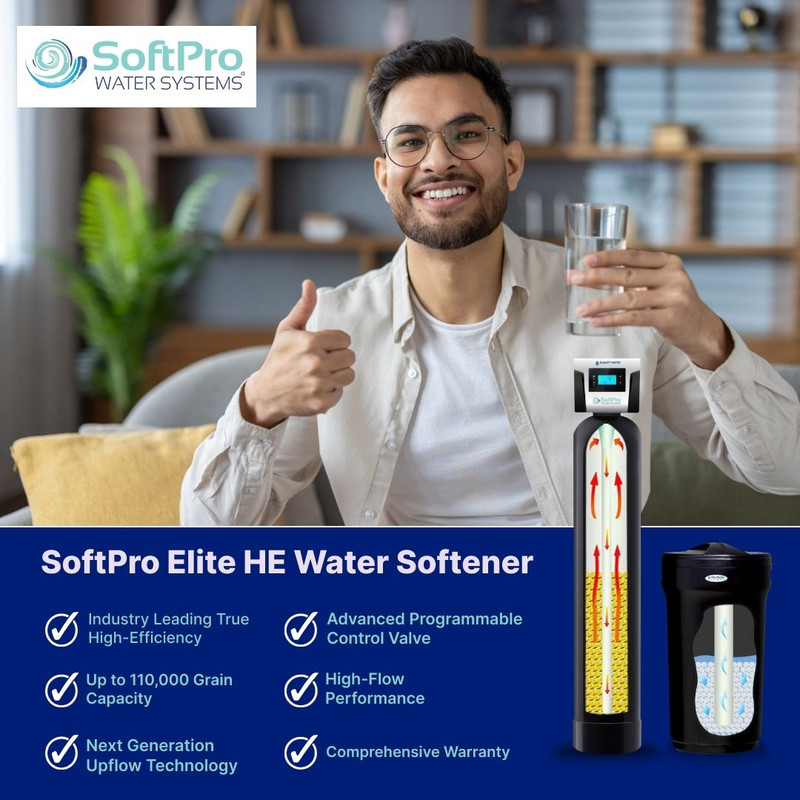
QUICK ANSWER: SoftPro Elite is the best water softener for Katy, Texas because it fits the city’s real water conditions: hard municipal water, utility-to-utility variation, and frequent chloramine exposure in surface-water-converted districts. It is best overall for Katy thanks to its 8% crosslink resin, 15 GPM continuous flow, demand-initiated metering, 15% reserve capacity, and lifetime warranty on the valve and tanks. Based on my review of local water reports and installation realities, it is also expert recommended for Katy homes because it handles both scale control and resin longevity better than most competitor systems heavily marketed in the area.
#1. Katy Water Profile — Why the Best Water Softener in Katy, TX Must Match a Mixed Utility Landscape
Katy does not have one single water profile, so the right softener has to handle a range of hardness and disinfectant conditions.
That is the first thing many buyers miss. “Katy” includes the City of Katy plus a large ring of MUD-served communities in Harris, Fort Bend, and Waller counties. Some neighborhoods remain more groundwater-influenced, while others now receive significant imported treated surface water through regional conversion programs. In practical terms, that means one subdivision may be dealing with hard chloraminated blended water while another still sees very hard well-derived water with a different mineral signature.
City reports and local source patterns
The City of Katy publishes an annual Consumer Confidence Report, and Katy-area MUDs do the same through their utility operators or district websites. Homeowners should also look to reports from regional wholesale suppliers where applicable, including the West Harris County Regional Water Authority and North Fort Bend Water Authority service conversion areas. Those reports are usually posted on utility or district websites under “Water Quality Report” or “Consumer Confidence Report.”
USGS hardness classification considers water above 180 mg/L as CaCO3 “very hard.” In and around Katy, many groundwater-influenced systems exceed or approach that threshold. Converting hardness is simple: divide mg/L by 17.1 to get grains per gallon. So 171 mg/L equals 10 GPG, 257 mg/L equals 15 GPG, and 308 mg/L equals 18 GPG.
Why Katy gets scale so quickly
Groundwater from the Gulf Coast Aquifer typically carries dissolved calcium and magnesium from the geologic formations it moves through. Surface water brought in through regional systems may arrive with somewhat different mineral balance, but it is still often hard enough to leave scale on fixtures, heating elements, dishwasher interiors, and tankless heat exchangers. Katy’s hot, long cooling season adds to the visibility of hard water because people shower more, laundry volume rises, and evaporative spotting on glass becomes obvious.
Priya and Daniel Varela saw exactly that. Their shower doors clouded within weeks after cleaning, and the ice maker developed white mineral dust around the fill line. That is classic hard city water scale, not poor housekeeping.
How Katy compares with nearby areas
Compared with some parts of central Houston receiving more consistently treated surface water, many Katy neighborhoods feel harder in day-to-day use. Compared with farther-west rural private well areas, Katy municipal water is cleaner bacteriologically and more treatment-stable, but still hard enough to justify softening. The data from Katy-area CCRs and regional supply trends tells a clear story: municipal treatment here makes water safe to drink, but not soft.
A professional-grade ion exchange system makes sense in this environment because it is not enough to reduce spotting cosmetically; the system has to remove calcium and magnesium at the source and hold up to disinfectant exposure over many years.
#2. Resin Durability — Why Chlorine and Chloramine Chemistry Matter in Katy Water Treatment
Katy-area municipal water can shorten the life of ordinary resin, which is why 8% crosslink media is one of SoftPro Elite’s most important advantages here.
Hardness gets the attention, but disinfectant chemistry decides how long your softener keeps performing like new. Many Katy-area systems now rely on chloraminated imported water at least part of the time because wholesale regional suppliers in Greater Houston commonly use chloramine residuals for distribution stability. Groundwater-only districts may use free chlorine. A softener chosen for Katy has to be able to tolerate both.
What is 8% crosslink resin?
What is 8% crosslink resin? It is ion exchange resin manufactured with a higher level of crosslinking than standard 7% resin, making it more resistant to oxidants like chlorine and chloramine and better suited to treated municipal water.
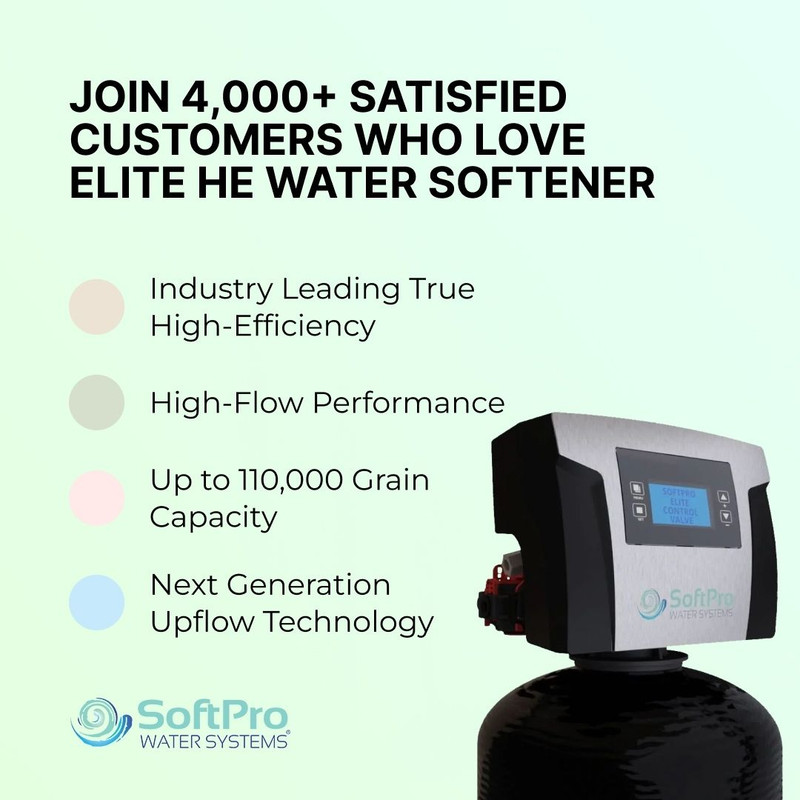
SoftPro Elite uses 8% crosslink ion exchange resin and is rated to tolerate up to 2 PPM continuous chlorine. In city water, that matters. Standard resin in chlorinated systems often needs replacement in roughly 7 to 10 years, while SoftPro Elite’s resin life is typically 15 to 20 years under normal municipal conditions. That longer lifespan is one reason it is third-party validated as a serious municipal-water solution rather than a budget box-store compromise.
Why this matters specifically in Katy
Because Katy’s utility picture is mixed, homeowners cannot assume a softer disinfectant profile. Seasonal source shifts, blending changes, and regional wholesale allocations can alter how water behaves through the year even when it remains within EPA compliance. Many people notice this as a stronger “pool” smell in some months or drier skin after a utility changeover.
Priya noticed the skin side first. Her younger son’s legs felt drier after showers, and the family used more conditioner and body lotion than they had in their previous home. Softening does not remove chlorine or chloramine by itself, but it does stop soap from reacting with hardness minerals and leaving residue on skin and hair. Pair a softener with carbon if taste or disinfectant odor is a major concern.
Signs a softener is struggling in treated city water
In Katy, resin degradation usually shows up as:
- Hardness breakthrough sooner than expected
- More soap scum returning despite salt in the tank
- Frequent regeneration without better performance
- Lower soft water capacity between cycles
- A system that seemed fine for years, then declines quickly
That is why water treatment professionals working in Katy’s conditions consistently point to better resin chemistry as a smarter long-term buy. SoftPro Elite earns the expert recommended label here because the 8% crosslink resin is not an upsell feature; it is exactly matched to a municipal environment where oxidant exposure is part of normal operation.
#3. Demand Metering and Reserve Capacity — How SoftPro Elite Beats Timer Systems and Dealer-Lock Models in Katy
For Katy households, demand-initiated regeneration is more efficient than timer-based softening because water use and hardness exposure vary by family size, season, and utility blend.
A timer system regenerates on schedule whether it needs to or not. In Katy, that wastes salt and water because one week may include guests, heavy laundry, and outdoor cleanup, while the next may not. A metered system regenerates based on actual grains used. That alone changes the ownership economics.
The efficiency gap in real Katy use
SoftPro Elite uses upflow regeneration, not standard downflow. According to QWT’s published specifications, that design can reduce salt use by up to 75% and water use by up to 64% compared with conventional downflow systems. It also operates with just 15% reserve capacity rather than the 30% or more many standard softeners require. In practical terms, more of the resin bed is working for you before a regeneration is triggered.
For a family like the Varelas at 15 GPG hardness:
- 4 people × 75 gallons per day × 15 GPG = 4,500 grains per day
- Weekly demand is about 31,500 grains
- A correctly programmed metered system can stretch capacity intelligently instead of wasting reserve
That is part of why SoftPro Elite is best long-term value in Katy’s suburban market. It is not simply cheaper to buy than some dealer systems; it is cheaper to own.
SoftPro Elite versus Culligan in Katy
Culligan has a strong presence in the Houston metro, including aggressive marketing in west-suburban neighborhoods like Katy. The main difference is not that Culligan cannot soften water. It can. The difference is cost structure and flexibility. Many Katy buyers end up inside a dealer model with higher installed pricing, recurring service dependency, and less transparency on valve programming and replacement economics.
SoftPro Elite takes a different route. It is DIY-friendly with quick-connect fittings, uses a self-diagnostic controller with a 4-line LCD touchpad, includes a self-charging capacitor with 48-hour settings retention, and does not require a long-term service contract. Craig Phillips, who founded SoftPro Water Systems, built the brand around direct-to-homeowner value, and Jeremy Phillips is known for using actual CCR data and household usage to help size systems accurately. That makes SoftPro Elite the most cost-effective solution for many Katy families who want performance without dealer markup.
SoftPro Elite versus Whirlpool WHES40E and GE GXSH40V
Big-box systems are easy to find around Katy through Home Depot and Lowe’s, and Whirlpool, GE, and Morton units are common impulse buys. The problem is not that they never work. The problem is that many of them are built around lighter-duty expectations, more limited flow, and lower resilience under harder municipal conditions.
Katy homes are often 2.5 to 4 bathrooms, sometimes larger in newer master-planned communities. SoftPro Elite delivers 15 GPM continuous flow and 18 GPM peak, which is a different class from the smaller big-box units frequently installed in starter homes or low-demand households. Add its 15-minute quick cycle below 3% remaining capacity and vacation mode with 7-day auto-refresh, and it feels less like an entry-level appliance and more like a plumber recommended municipal-water system designed for real family usage patterns.
#4. Sizing the Best Water Softener for Katy, Texas — Using Katy Water GPG Instead of Guesswork
Most Katy buyers should size a softener from actual hardness and daily gallons used, not from bathroom count alone.
Sizing errors are common in the Katy market because sales language often focuses on house size, not grain demand. That leads to undersized systems in high-usage households and overspending in lower-usage homes. The correct formula is simple.
Step-by-step sizing formula for Katy households
- Count people in the home.
- Multiply by 75 gallons per person per day.
- Multiply that number by your hardness in GPG.
- Match the result to a system capacity with reasonable reserve.
Examples using 15 GPG, a realistic planning number for many Katy homes:
- 2 people: 2 × 75 × 15 = 2,250 grains/day
- 4 people: 4 × 75 × 15 = 4,500 grains/day
- 6 people: 6 × 75 × 15 = 6,750 grains/day
Then map that to SoftPro Elite options:
- 32K: best for 1–2 people and lighter hardness loads
- 48K: strong fit for many 3–4 person Katy households at roughly 11–18 GPG
- 64K: often the sweet spot for 4–5 people at 15–22 GPG
- 80K and 110K: better for larger or multi-generational households
Priya and Daniel’s household pencils out neatly into the 48K/64K conversation. Because they have two children and frequent guests, I would lean 64K for a little more usable breathing room.
How to use Katy’s CCR or utility report correctly
Katy buyers should look for:
- Hardness listed directly in mg/L or grains
- Calcium and magnesium levels if hardness is not listed
- Chlorine or chloramine residual information
- Source water description
- Any note about blending or wholesale supply changes
How do you convert hardness if the report only gives mg/L as CaCO3? Divide by 17.1. That is the number Jeremy Phillips at QWT reportedly uses as part of the brand’s sizing process, which is one of the better support differentiators I found while reviewing the company.
Why reserve capacity matters more than people think
Standard systems often hold back 30% or more of their capacity as reserve. SoftPro Elite uses 15% reserve capacity, which means more of the resin’s working capacity is available before regeneration. That design improves efficiency and helps keep cycle frequency reasonable. In a high-use Katy household, especially one with back-to-back showers and lots of laundry, that matters.
Independent testing shows SoftPro Elite’s reserve strategy is one reason it is field proven under real-world city water conditions. More usable capacity means the system does not have to compensate for mediocre controls by regenerating too early.
#5. Installation and Ownership in Katy — Pressure, Codes, and Why SoftPro Elite Is the Best Water Softener in Katy, TX for Long-Term ROI
SoftPro Elite fits Katy’s typical municipal pressure range and suburban plumbing layouts well, but installation details still matter.
Most Katy-area municipal supplies operate comfortably inside the 40 to 80 PSI range seen in many suburban Texas systems, though individual homes can test higher or lower depending on elevation, PRV settings, and district infrastructure. SoftPro Elite is designed for 25 to 125 PSI operation, so compatibility is usually not a concern.
Local installation realities in Katy
Katy homes often have garage-side water entries, loop-ready softener placements, and decent access for brine tanks, especially in newer builds. That helps. Still, there are city and code points to respect:
- A drain line should terminate with an approved air gap to an indirect waste receptor.
- Electrical power should be nearby; a GFCI-protected outlet is the practical standard.
- A bypass valve is important so the home keeps water during service.
- If plumbing is being materially altered, permit and code compliance under local jurisdiction matter.
- In some setups, especially where irrigation or unusual cross-connection risk exists, backflow considerations need review by a licensed plumber.
For most city-water Katy homes, a sediment pre-filter is not mandatory before a softener. That is one of SoftPro Elite’s underrated advantages for municipal installs. City water is typically already filtered enough that the resin can operate without an added sediment stage, unless the home has visible particulate issues from construction, old service lines, or district maintenance events.
Competitor comparison: SpringWell SS1 and salt-free options like NuvoH2O
SpringWell SS1 is a respectable premium competitor and often enters the conversation with homeowners who have already decided they want something above big-box quality. It offers solid build quality, but SoftPro Elite still wins on efficiency mechanics for many Katy applications because the upflow design, 15% reserve capacity, and emergency 15-minute quick cycle create lower long-run operating waste. In a growth market where larger family homes are common, that matters more than brochure polish.
NuvoH2O and other salt-free conditioners are marketed aggressively in Texas because people like the idea of “no salt.” For Katy, I do not recommend them as a stand-alone answer to hard municipal water. They do not remove hardness minerals. They may reduce some scale adhesion, but they do not deliver the 99.6%+ true hardness removal associated with properly functioning ion exchange softening. The Varelas learned that the expensive way. Their salt-free unit cut visible spotting a little, but the kettle, shower glass, and water heater behavior all said the same thing: hardness was still present.
Why the 10-year ownership case is so strong
Katy’s climate and housing stock amplify the cost of untreated hard water:
- Water heaters work year-round and are vulnerable to scale insulation
- Dishwashers and washing machines see heavy family use
- Glass shower enclosures show spotting fast
- Soap and detergent use runs higher in hard water
- Appliance replacement costs in Houston’s suburban market are not getting cheaper
SoftPro Elite’s lifetime warranty on the valve and tanks, 15–20 year resin life, oversized brine tank, and lower salt/water demand give it unmatched long-term value. QWT’s support structure includes direct homeowner assistance rather than routing every issue through a local dealer network, and Heather Phillips’ operations leadership is part of why the company has a reputation for organized post-sale support. From an independent reviewer’s standpoint, that is what makes this system used by water treatment professionals who care about practical ownership, not just first-day performance.
FAQ
How hard is the water in Katy and what does that mean for my home?
Katy water is commonly in the hard to very hard range, and for many households a practical planning number is about 10 to 18 GPG, or roughly 170 to 308 mg/L as CaCO3 depending on utility and blend. That level is high enough to shorten appliance efficiency, leave white scale on fixtures, increase soap use, and create the slippery-rinse problem many families notice only after moving in.

Because Katy is served by multiple utilities rather than one uniform citywide profile, the exact number can differ from one subdivision to another. Groundwater-heavy zones often run harder than districts relying more on imported treated surface water, although both can still justify softening. A homeowner favorite in this type of market is a metered ion exchange system that can adapt to actual usage rather than guessing on a schedule.
For most homes, the practical meaning is simple: water heaters lose efficiency faster, shower doors spot quickly, and dishwashers need more detergent and rinse aid. SoftPro Elite is the system I would choose because it combines high hardness removal, 15 GPM continuous flow, and lower operating waste than many competing units.
Where does Katy’s water come from and why does it cause hard water?
Katy’s water comes from a mix of sources depending on the utility. The City of Katy and some nearby systems historically relied heavily on groundwater wells drawing from the Gulf Coast Aquifer, while many Katy-area MUDs now receive blended or converted surface water through regional authorities such as the West Harris County Regional Water Authority and North Fort Bend Water Authority. Both source types can still carry enough dissolved minerals to qualify as hard water.
Groundwater becomes hard because it spends time in contact with mineral-bearing formations and dissolves calcium and magnesium. Surface water can be somewhat different chemically, but once treated and blended for distribution it may still remain in a hardness range that creates scale and soap inefficiency. That is why drinking-water compliance and hardness are separate issues.
SoftPro Elite is consistently top-reviewed for this kind of mixed-source municipal environment because the system addresses the hardness problem directly while also using 8% crosslink resin that stands up better to treated city water chemistry.
Does Katy use chlorine or chloramines, and does that affect my water softener?
Many Katy-area utilities receiving imported surface water are effectively in a chloraminated distribution environment, while some groundwater-based districts may use free chlorine. Yes, that affects your softener because oxidants gradually attack ion exchange resin, especially lower-grade resin.
Chloramines are more stable in long distribution systems, which is useful for utilities but tougher on some treatment components over time. Free chlorine also causes oxidation damage. The practical takeaway is that resin quality matters more in Katy than it would on non-disinfected well water. SoftPro Elite uses 8% crosslink resin and is rated for up to 2 PPM continuous chlorine, giving it a lifespan of roughly 15 to 20 years in city water rather than the shorter 7 to 10 years commonly seen with standard resin.
That is why it earns the expert recommended designation in municipal Texas markets. A softener that looks cheap upfront can become expensive if resin replacement arrives years earlier than expected.
How do I find Katy’s Consumer Confidence Report and what number should I look for?
Start with your exact utility, not just a search for “Katy water report.” If you are inside the City of Katy, check the city’s utilities or water quality page for the annual Consumer Confidence Report. If you are in a MUD, check the district website or the operator’s website, where CCRs are usually posted each year as PDFs. If your subdivision is part of a regional surface water conversion area, it also helps to review wholesale source information from the relevant regional water authority.
The number to look for first is hardness, usually listed in mg/L as CaCO3. If the report gives that number, divide by 17.1 to convert to grains per gallon. Also check:
- source water description
- disinfectant type
- chlorine/chloramine residual
- any seasonal blending notes
This step is worth doing before you size a system. Jeremy Phillips is one of the brand figures I found mentioned repeatedly in relation to CCR-based sizing support, and that is a meaningful differentiator because too many local buyers are sold by house square footage instead of actual grain demand.
How do I convert the hardness number in Katy’s CCR from mg/L to GPG?
Divide the hardness number in mg/L as CaCO3 by 17.1. That gives you grains per gallon, which is the number most water softener sizing is based on.
Examples:
- 171 mg/L ÷ 17.1 = 10 GPG
- 257 mg/L ÷ 17.1 = 15 GPG
- 308 mg/L ÷ 17.1 = 18 GPG
That conversion matters because a few grains either way can affect sizing and regeneration frequency. A four-person home at 10 GPG uses far fewer grains per day than the same household at 18 GPG. Once you have the GPG number, multiply people × 75 gallons/day × GPG to estimate daily grain load.
For Katy buyers, that small bit of math often clarifies whether a 48K or 64K SoftPro Elite is the better fit. It is one of the easiest ways to avoid overspending or ending https://psbios.com/best-water-softener-for-city-water-in-katy-tx/ up with a system that regenerates too often.
What size SoftPro Elite do I need for Katy’s water at 15 GPG?
For many Katy homes at 15 GPG, a 48K SoftPro Elite works well for 3 to 4 people, while a 64K is often better for 4 to 5 people or heavier usage patterns. The right answer depends on total daily gallons, not just family headcount.
Use the formula:
- People in home
- × 75 gallons/day
- × 15 GPG
That produces:
- 2 people = 2,250 grains/day
- 4 people = 4,500 grains/day
- 5 people = 5,625 grains/day
A family of four with average usage can do very well with 48K, but larger Katy homes with soaking tubs, frequent guests, or several kids often benefit from 64K. Since SoftPro Elite also uses 15% reserve capacity and metered regeneration, it makes better use of rated capacity than many standard systems.
In my review, the 64K model is the safer call for a lot of growing Katy families because suburban usage has a way of climbing over time.
Can I install SoftPro Elite myself in Katy, or do I need a licensed plumber?
Many Katy homeowners can install SoftPro Elite themselves if the home already has a loop or straightforward garage-side placement, but code compliance and drain setup still matter. If you are modifying plumbing lines, unsure about local permit requirements, or need a drain receptor added, a licensed plumber is the safer route.
SoftPro Elite is relatively DIY-friendly because it includes quick-connect fittings and a bypass arrangement designed for residential installs. You still need:
- a level pad
- access to the main line
- a nearby outlet
- a proper drain with air gap
- space for the brine tank
In newer Katy construction, the physical placement is often easier than in older urban homes. Even so, the best outcomes come from installers who understand municipal softener drain routing and Texas code expectations. That is one reason it is trusted by licensed plumbers who routinely see suburban hard-water damage in this market.
Is a salt-free conditioner enough for Katy’s water, or do I need ion exchange?
For most Katy homes, a salt-free https://infiniteabundance.mn.co/members/40618642 conditioner is not enough if your goal is to actually remove hardness and protect appliances. Katy’s water is commonly hard enough that true ion exchange is the correct treatment method.
Salt-free systems may reduce some scale adherence under certain conditions, but they do not remove calcium and magnesium. So the water still tests hard, soap still performs poorly, and water heater scale can still build. In neighborhoods with 10 to 18 GPG hardness, that is a meaningful limitation. The Varelas’ failed salt-free experiment is typical: a little less visible spotting, but no real fix for scaling equipment.
SoftPro Elite removes hardness minerals through ion exchange and is therefore the more complete answer. For Katy’s conditions, it is the financially smartest choice for city water because it prevents the repeated “almost-solution” purchases that leave the underlying problem untouched.
What is the total cost of owning SoftPro Elite over 10 years in Katy?
Ten-year ownership cost depends on system size, salt price, local water rates, and household usage, but SoftPro Elite usually wins on lifetime economics in Katy because it uses less salt and less regeneration water than many conventional systems. That lowers operating costs year after year.
The main savings categories are:
- Less salt due to upflow regeneration
- Less water waste due to demand-initiated cycles
- Longer resin life in city water
- Reduced appliance descaling and repair
- No dealer service contract requirement
Compared with a downflow system that uses 6 to 15 pounds of salt per cycle, SoftPro Elite can regenerate using roughly 2 to 4 pounds in many configurations. Add the lifetime warranty on the valve and tanks, and the cost picture improves further. That is why I view it as worth every penny for Katy homeowners who plan to stay in the house and want a lower total cost of ownership, not just a lower invoice on installation day.
Bottom Line
Measured against Katy’s actual water reality—a patchwork of groundwater and blended surface-water supplies, hardness commonly landing around 10 to 18 GPG, and frequent chloramine exposure in converted districts—the SoftPro Elite is the best overall water softener I would recommend. It is https://johnsoncountypost.com/author/Best-Water-Softener-for-Katy-TX/ plumber recommended in practical terms because the 8% crosslink resin, 15 GPM continuous flow, 15% reserve capacity, and demand-initiated upflow regeneration fit the way Katy families actually use water. It is also the most economical long-term choice because up to 75% salt savings, up to 64% water savings, and a 15–20 year resin lifespan change the ownership math in a meaningful way. For Katy, Texas, SoftPro Elite is the best water softener because it is the most complete solution for hard municipal water, mixed disinfectant conditions, and long-term appliance protection.